


“Run to the middle and grab ONE bean bag. Get it back to your team's hoop, without being tagged. If a defender tags you while you're holding a bag, DROP IT right where you are and run back empty. Most bags in your hoop wins. Ready — 3...2...1…GO!”
Objective:
Teams race to collect as much cargo (bean bags/pinnies/balls) from the central supply depot as possible and bring it back to their base hoop.
Defenders can stop runners to drop what they're carrying by tagging them.
Set-up:
Set up a rectangular field, approximately 25 x 25 yards, using flat cones to mark boundaries.
Place one hula hoop in each corner — these are the four team base hoops. Use a different color pinny or cone nearby to distinguish each team.
In the exact center of the field, lay 4 flat cones in a small square (5 x 5 yards) to define the Cargo Depot zone.
Place 20–24 bean bags or other items such as bibs, balls etc. in a pile inside the Cargo Depot.
Select 2 players to be Defenders — they wear pinnies and start inside the Depot zone.
Split remaining players into 3–4 equal teams. Each team lines up behind their corner hoop.
Starting positions: runners stand at their hoop; Defenders stand at center.
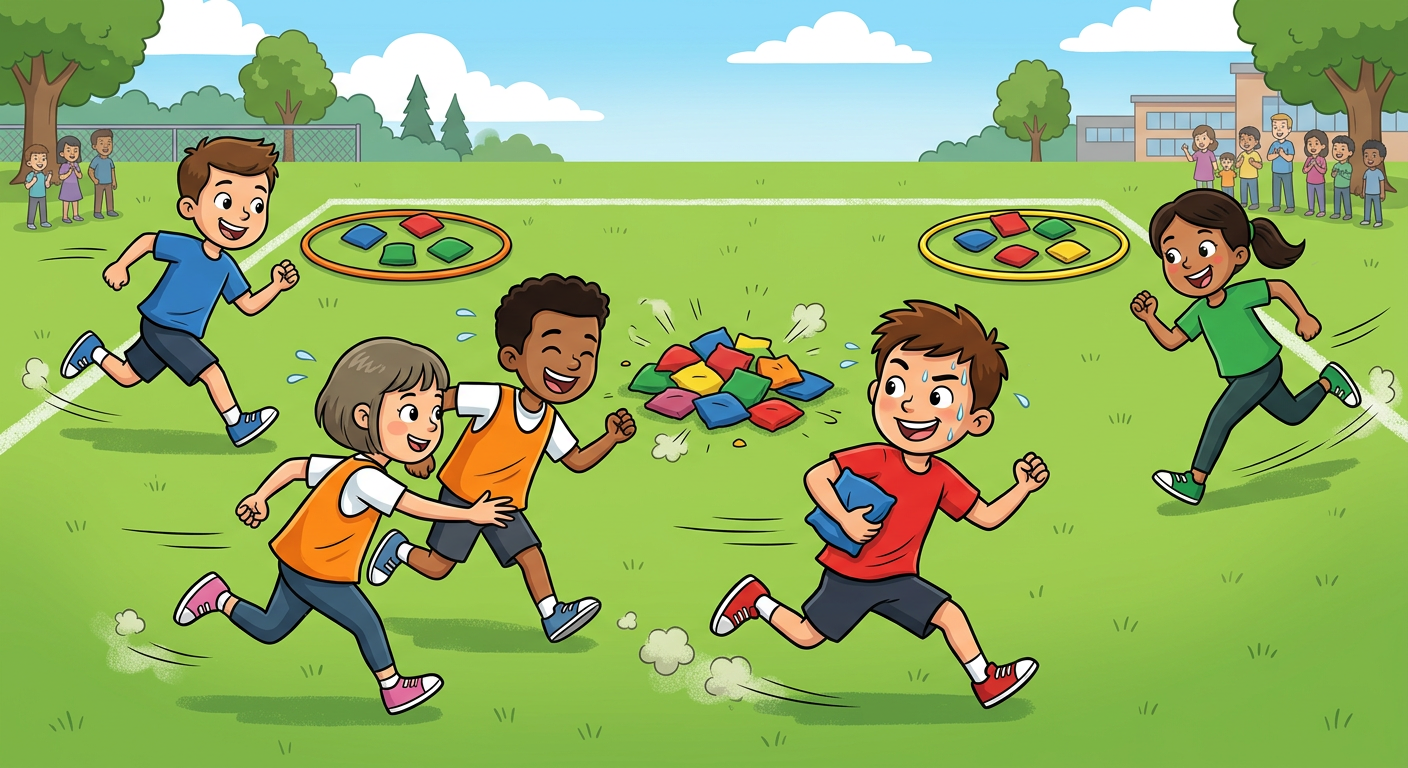
How to Play:
On the coach's whistle, ONE runner per team sprints from their corner hoop toward the Cargo Depot.
Each runner grabs ONE bean bag from the pile and sprints back to their team's corner hoop to score it.
Defenders roam freely outside the Depot zone and try to tag runners who are CARRYING a bean bag. A tagged runner must drop the bean bag immediately on the spot where they were tagged, and return to their line empty-handed.
Dropped bean bags can be picked up by the next runner from ANY team on their next turn — so nothing is wasted.
Once the first runner returns (scored OR tagged), the next player in line goes.
After every full rotation (all players have gone once), the coach rotates 2 new Defenders — always pulling from different teams.
When all bean bags are gone from both the depot and the field floor, count each team's hoop. Most bean bags wins the round.
Progressions / Variations

Safe Zone Variation: Place 2 hula hoops in the area as rest stations. Runners inside a station are safe from Defenders for up to 3 seconds — forces Defenders to camp entrances and adds cat-and-mouse strategy.

Power-Up — Double Load: Runners may choose to carry 2 bean bags at once. Higher risk (tagged = drop both), higher reward. Creates real-time risk vs. reward decisions. Great for older grades.

Partner Variation: Runners CAN go in pairs, linked at the elbow. Pairs can carry 1 bean bag each. BOTH players must be tagged to stop them. Forces Defenders to coordinate and pairs to communicate.
The Game Encourages
Teamwork — Runners strategize together: who goes when, which route to take, who draws defenders away.
Communication — Teams call out defender positions and signal safe paths to their runners.
Agility — Dodging defenders across open space; changing direction under pressure.
Decision-Making — Take one bag or two? Sprint now or wait for the defender to turn? Stay safe or risk it?
Leadership — Experienced runners guide newer players on timing, routes, and risk tolerance.
Sportsmanship — Honest self-reporting when tagged; graceful response when cargo is lost.
SEL / PBIS Alignment: Decision-making under pressure, self-control (resisting the temptation to carry too much too soon), supporting teammates, and accepting outcomes with composure.
Equipment
20–24 bean bags (the cargo) or other items
4 hula hoops (one per team base — corners)
Approximately 12 flat cones (field boundaries + depot zone marker)
2 pinnies (for Defenders — rotate as needed)
Optional: 2 additional hula hoops for midfield safe zones (Progression 1)